Red light therapy panels are heavily marketed for skin, inflammation, and recovery — with sleep often added as a secondary benefit. The honest picture is that the sleep-specific evidence is real in a narrow sense, and considerably overstated in a broader one. Here's where the boundary actually sits.
Red Light and Melatonin: The Mechanism That Is Well-Supported
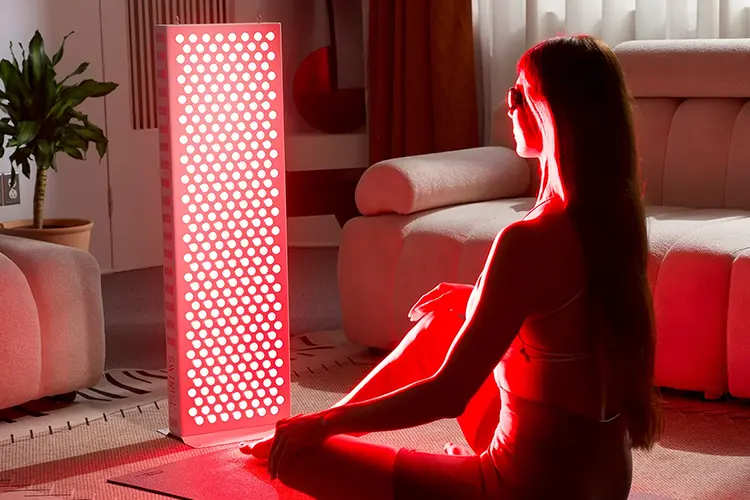
The most solid and well-established aspect of the red light-sleep relationship is photobiological: red and near-infrared light wavelengths (typically 600–900nm) do not meaningfully activate the melanopsin-containing intrinsically photosensitive retinal ganglion cells (ipRGCs) that drive the melatonin-suppression pathway.
These ipRGCs are maximally sensitive to short-wavelength blue light (around 450–480nm), which is why blue-enriched light from screens and modern LED lighting delays melatonin onset and disrupts circadian timing. Red light, sitting at the far end of the visible spectrum, doesn't trigger this pathway in the same way — a finding supported across multiple photobiological studies.
A 2025 study comparing the effects of red LED (631nm) and blue LED (464nm) exposure on melatonin secretion over three hours of evening exposure confirmed that red light produced no significant melatonin suppression, while blue light produced substantial suppression. This is the strongest, most reproducible part of the evidence base connecting red light to sleep — and it's a negative finding: red light doesn't cause the problem, rather than actively solving one. For wider context on how light timing affects the circadian system, see our full guide to the causes of poor sleep.
Active Sleep Improvement: Where the Evidence Gets Thinner
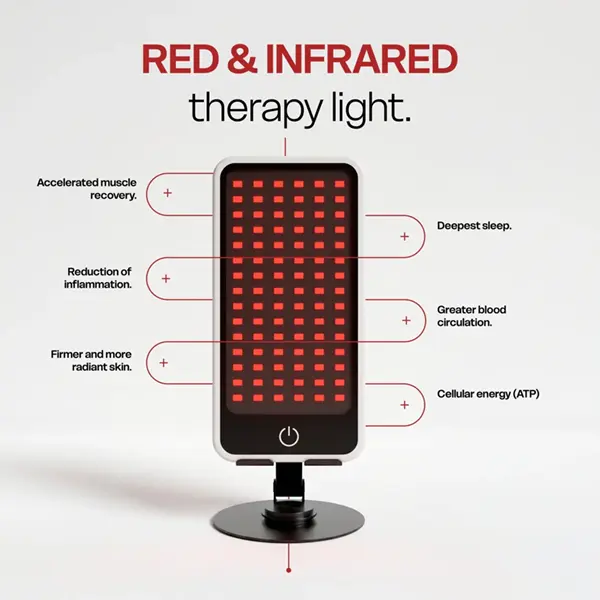
The leap from "red light doesn't suppress melatonin" to "red light therapy improves sleep quality" is where the evidence becomes substantially weaker — and where much of the marketing lives.
A smaller number of studies have examined whether red light panel exposure actively improves sleep outcomes such as sleep latency (how long it takes to fall asleep), total sleep time, or sleep quality scores. The results from this specific area are mixed, with some smaller trials showing modest improvements and others showing no significant effect. Sample sizes are typically small, and study designs vary considerably — making it difficult to draw a confident general conclusion about active sleep benefit independent of the avoidance-of-blue-light effect.
It's also worth noting where the majority of published red light and photobiomodulation (PBM) research actually sits: dermatology, wound healing, inflammation, and musculoskeletal recovery. Sleep is a newer and smaller area of investigation, sometimes extrapolated from the broader body of PBM research rather than studied directly for that outcome.
What Red Light Therapy Can't Replace
For anyone dealing with persistent poor sleep, it's important to frame red light therapy at its appropriate level in the solution stack. It is not a treatment for sleep apnoea, circadian rhythm disorders, chronic insomnia with a psychological component, or stress-related sleep disruption. If any of those are present, they need to be addressed directly.
Red light therapy as an evening substitute for blue-enriched lighting is a reasonable, low-risk practice grounded in solid photobiology. The same circadian benefit can also be achieved by dimming screens, using warm (low-colour-temperature) LED lighting in the evenings, and reducing overhead bright lighting — all at substantially lower cost than a dedicated panel.
The Honest Practical Position
If you already own a red light panel or are considering one primarily for recovery or skin purposes, using it in the evening rather than under bright LEDs aligns with what the photobiology does support: avoiding melatonin suppression. That's a legitimate secondary sleep benefit worth having.
If you're considering a red light panel primarily as a sleep improvement tool on the basis of marketing claims about actively improving sleep quality, the evidence for that specific claim is thinner and more mixed than the marketing implies, and there are more cost-effective, better-evidenced first steps to try.
Frequently Asked Questions
No. Red and near-infrared wavelengths do not activate the melanopsin pathway that drives melatonin suppression the way blue light (around 450–480nm) does. This is the strongest and most consistently supported part of the sleep evidence base for red light.
The evidence for an active sleep quality improvement beyond avoiding blue-light melatonin suppression is more limited and mixed. It is a reasonable, low-risk practice, but shouldn't be marketed as a proven standalone sleep treatment.
Yes — the largest body of supporting research for photobiomodulation is in dermatological and recovery applications. Sleep is a smaller, less-established area of study, sometimes added as a secondary claim to skin-focused product marketing.
Reducing blue-enriched light in the evening is grounded in solid circadian science. A red light panel is one approach, but dimmed warm LED lighting and screen-dimming achieve similar circadian protection at lower cost. The choice depends on your budget and whether you also want the other claimed PBM benefits.
LessStress.ie
LessStress.ie covers neuro-tech devices, sleep science and brain health for an Irish audience, with every product claim checked against the real peer-reviewed evidence before it gets a recommendation.
Related Articles
Sources & Further Reading
- Novotny, P., Horníková, J., & Kremlíček, J. (2025). Comparative Effects of Red and Blue LED Light on Melatonin Levels During Three-Hour Exposure in Healthy Adults. Life, 15(5), 715. View on PMC ↗
- Harvard Health Publishing. (2024). Blue light has a dark side. Harvard Medical School. View Article ↗
- Rahman, S.A., Flynn-Evans, E.E., Aeschbach, D., Brainard, G.C., Czeisler, C.A., & Lockley, S.W. (2017). Diurnal spectral sensitivity of the acute alerting effects of light. Sleep, 37(7), 271–281. View on PMC ↗