Nurosym is one of the most marketed transcutaneous vagus nerve stimulation (taVNS) devices currently sold to consumers — and it has a more substantial research backing than most competitors. But "more research than the others" isn't the same as "research that backs the claims on the box." Here's what the evidence actually shows, and where the gap between research and marketing appears.
What Nurosym Is: The Device and the Mechanism
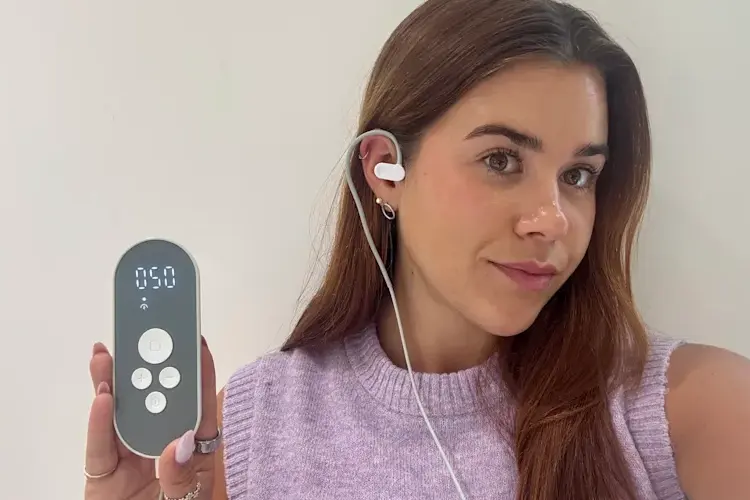
Nurosym is a non-invasive taVNS device worn as a clip on the outer ear, delivering mild electrical stimulation to the auricular branch of the vagus nerve — a vagal branch accessible at the skin's surface near the cymba conchae (the upper hollow of the outer ear). It's marketed for stress, sleep, recovery, HRV improvement, and a range of associated wellness outcomes.
The mechanism — auricular vagal stimulation — is biologically grounded and backed by a genuine, if still-developing, body of research. For background on what the vagus nerve is and how taVNS is supposed to work, our vagus nerve explainer and our guide to the evidence for VNS and anxiety cover those foundations.
CE Marking: What It Certifies — and What It Doesn't
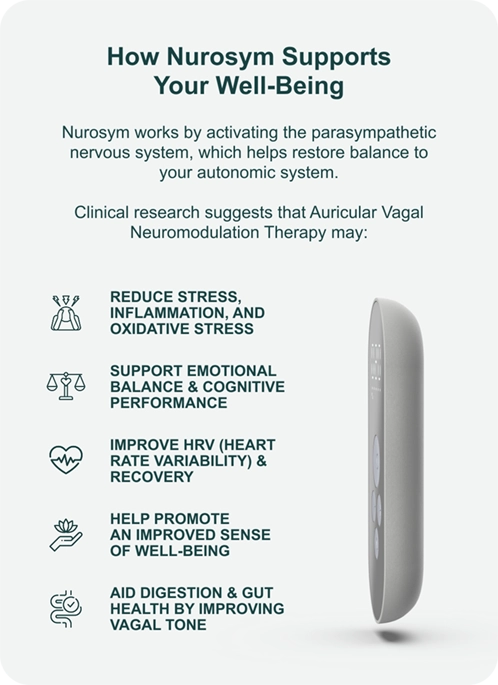
Nurosym carries CE marking, which means it meets EU regulatory requirements for its registered medical device class. This is a meaningful baseline: it confirms the device has met safety and performance standards for its intended registered use, and it is not a trivial certification.
What it is not: a regulatory approval of every specific wellness claim made in the device's marketing. CE marking operates at the level of device classification and safety, not claim-by-claim efficacy verification. A CE-marked taVNS device and a CE-marked blood pressure monitor both carry the same marking; it doesn't mean the taVNS device's specific claims about stress, sleep, or anxiety have been independently verified by a health authority in the way a pharmaceutical drug approval would require.
This distinction matters because Nurosym's marketing — like most medical wearable marketing — implies a level of regulatory validation that CE marking does not technically confer for specific symptom claims.
What Nurosym's Clinical Research Actually Found
Nurosym and its underlying taVNS technology have been used in a number of peer-reviewed studies, including research on HRV, inflammatory markers, and specific patient populations including those with long COVID and certain cardiac conditions. Several of these studies have produced genuinely encouraging results and represent more rigorous research than most competing wearables can point to.
The honest caveats: most published trials are small by clinical-trial standards, with sample sizes often in the tens rather than hundreds of participants. Studies with specific clinical populations — long COVID patients, people with defined cardiovascular conditions — may not generalise to healthy adults seeking everyday stress relief, which is the primary consumer market.
There is also a pattern worth noting across the taVNS literature generally: studies frequently measure physiological markers (HRV, inflammatory cytokines, autonomic indices) as primary outcomes, not validated symptom-level measures (anxiety scales, sleep quality questionnaires, quality-of-life tools). A study demonstrating improved HRV does not automatically demonstrate improved anxiety or better sleep — those require their own measurement. When marketing translates a physiological finding into a broader symptom claim, that's the gap to scrutinise.
On Institutional Research Associations
Devices in this category frequently cite associations with well-known research institutions to imply a level of validation that the underlying research may not fully support. We have not independently verified specific partnership claims beyond what is stated in published research materials, and we'd encourage anyone evaluating this type of claim to go directly to the published papers rather than the marketing summary of them. The question to ask is: what exactly was studied, in what population, and with what outcome measures?
Our Verdict: Better Than Most, But Not Proven at Scale
Nurosym has a more credible research foundation than the vast majority of consumer taVNS products on the market. The auricular vagal stimulation mechanism is biologically plausible and supported by a genuine, growing evidence base. For someone who has already decided they want a taVNS device, it's a more defensible choice than most alternatives.
The honest summary is: promising and better-supported than most, but not yet backed by the kind of large-scale, broad-population, placebo-controlled evidence that would justify the more sweeping wellness claims in its marketing. That's not a dismissal — it's the accurate description of where the evidence currently sits, and it's where we apply the same standard we apply to every product reviewed on this site.
For a direct comparison with Sensate, the other major device in this space, see our Nurosym vs Sensate evidence comparison.
Frequently Asked Questions
No — it is sold direct to consumers as a wellness wearable rather than a prescription-only medical device.
CE marking confirms the device meets EU safety and performance standards for its registered device class. It does not certify that every specific wellness claim in the marketing material has been independently verified by a regulator.
Yes — peer-reviewed studies exist on taVNS technology and Nurosym specifically. Sample sizes in most published trials are modest, and many focus on physiological markers rather than broad stress or sleep improvement outcomes.
Nurosym uses electrical stimulation of the auricular vagus nerve; Sensate uses chest vibration. They work through different mechanisms and have different depths of supporting evidence. We compare both in detail in our Nurosym vs Sensate guide.
LessStress.ie
LessStress.ie covers neuro-tech devices, sleep science and brain health for an Irish audience, with every product claim checked against the real peer-reviewed evidence before it gets a recommendation.
Related Articles

Sources & Further Reading
- Berthoud, H.R. & Neuhuber, W.L. (2000). Functional and chemical anatomy of the afferent vagal system. Autonomic Neuroscience, 85, 1–17. View on PubMed ↗
- Ferreira, L.M.A., et al. (2024). Transcutaneous auricular vagus nerve stimulation modulates masseter muscle activity, pain perception, and anxiety levels. Frontiers in Integrative Neuroscience, 18. View on PMC ↗